
Who Owns Which Date? Questions Before Signing a Vegan Order
Signing is the last cheap moment to fix a launch calendar. After the deposit clears, every date that is not in the contract becomes a favour, and favours are unreliable in a factory that is running other projects. Ten questions cover most of the schedule risk on a first vegan-positioned order, and four of the answers belong in writing as clauses rather than as understanding. Ask them before the pen, not after the first delay.
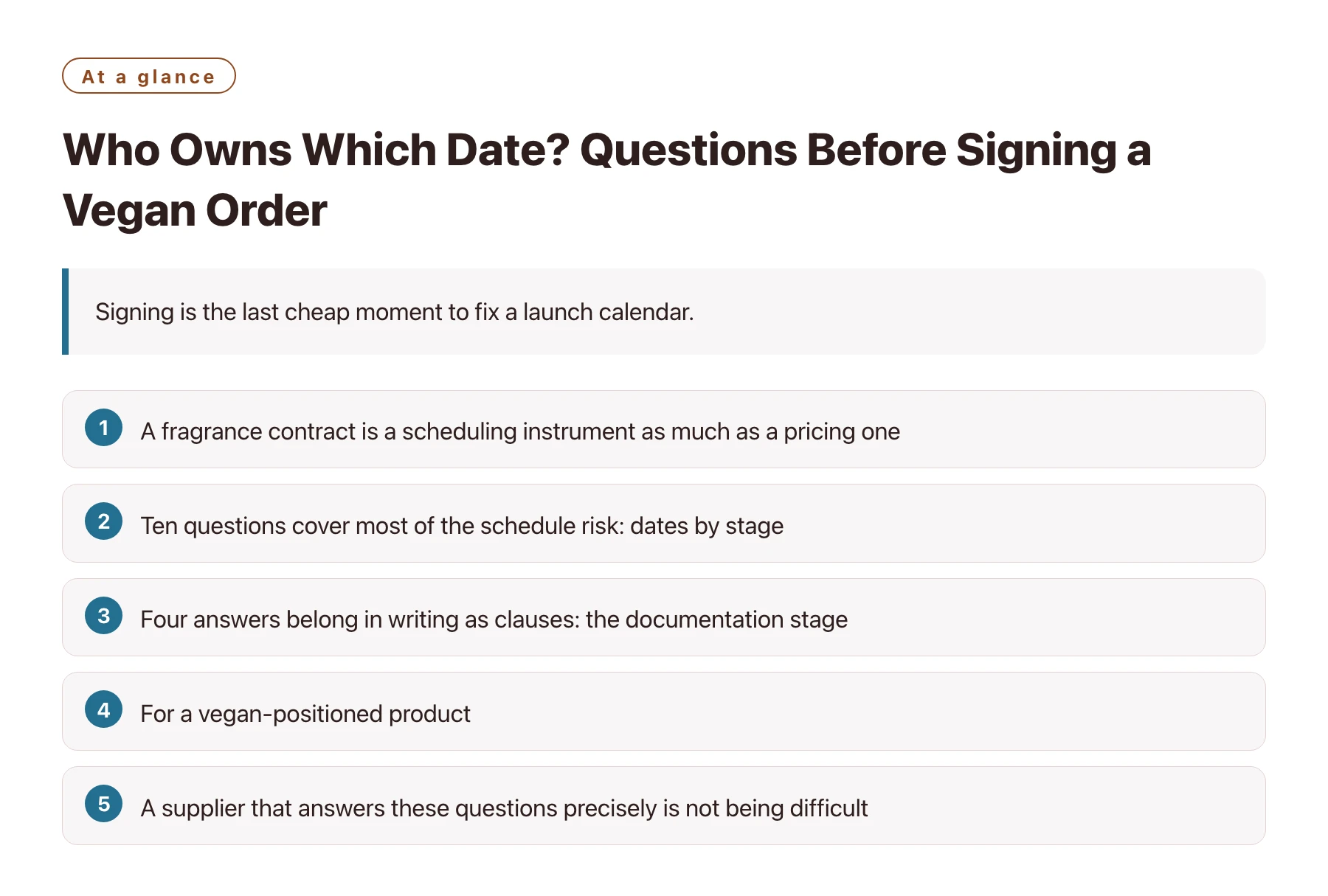
Key takeawaysA fragrance contract is a scheduling instrument as much as a pricing one, because it fixes who owns each date in the launch calendar. · Ten questions cover most of the schedule risk: dates by stage, revision rounds, sample ownership, documentation ownership, change notice, release criteria, delay remedies, capacity, packaging responsibility and termination. · Four answers belong in writing as clauses: the documentation stage, the revision allowance, the change-notification duty and the release criteria. · For a vegan-positioned product, the documentation clauses carry more weight than the price schedule, because the claim cannot be defended without them. · A supplier that answers these questions precisely is not being difficult; it is showing that the project has a plan behind the quote.
First-time founders tend to treat the contract conversation as a formality that follows a successful negotiation. In practice it is the negotiation, because a fragrance project is mostly a sequence of dates owned by different people, and the contract is where ownership is either assigned or left ambiguous.
Ambiguity has a predictable cost. If the contract does not say when material statements are collected, they are collected when someone remembers. If it does not define release criteria, the bulk run is released against an impression of the sample. If it does not require notice of a material change, the vegan claim quietly expires while the cartons stay the same.
The questions below are written for a founder signing a first manufacturing agreement for a vegan-positioned fragrance product. They are ordered by how much schedule risk each one removes, and they are phrased so that a supplier can answer them factually without treating the conversation as an interrogation.
Why the contract decides the calendar
A quote describes work; a contract describes obligations. The difference matters most at the moments when the two parties disagree about whether something was included, which on a fragrance project is almost always a revision round, a document, or an approval.
Fixing those three things in writing does not require a hostile agreement. It requires specificity about what triggers each stage, who acts when it is triggered, and what happens if it is not. Suppliers generally prefer this, because it protects them from scope creep as much as it protects you from delay.
The nuance for a positioned product is that some obligations run outside the factory entirely. Material statements originate with raw material suppliers, and labelling expectations differ by market, which means the contract has to distinguish between obligations the factory can control and obligations it can only pursue. Both belong in the plan; only the first belongs in a penalty clause.
Distinguish an obligation from a target
A date that the factory controls, such as the start of compounding once components are in the warehouse, can reasonably be written as an obligation. A date that depends on a third-party supplier statement is better written as a target with a notification duty, because a missed target should produce information rather than a dispute. Contracts that blur the two tend to be argued about rather than used.
Ten questions, in the order they remove risk
- 1. What are the dates, stage by stage?Ask for brief to sample, sample to approval, documentation, and production to release as separate committed dates. A single delivery date tells you nothing about where the risk sits.
- 2. How many revision rounds are included, and what does the next one cost?Get a number and a price. An open-ended revision promise is not a term, and the second round is where most first projects lose a fortnight.
- 3. Who holds the retained reference sample?Both parties should hold one, referenced by date and batch. If only one side keeps it, the comparison at release is against memory.
- 4. When are material statements and allergen information collected, and by whom?This is the vegan clause. It should name a stage and a responsible party, not a promise to handle it. Ingredient naming for labelling purposes is checked against the European Commission's ingredient database in the EU market, which is why label wording cannot be finalised before the documentation stage completes [1].
- 5. What notice will I receive if a material, supplier or process changes?Change control is what keeps a claim valid after delivery. Ask for notice within a stated period, in writing, with the affected batch and revision identified.
- 6. What are the release criteria for the bulk run?The contract should say what the batch is compared against: the retained reference sample, the agreed specification, or both. Without this, release is a judgement call.
- 7. What happens if a stage slips beyond its date?Ask for the remedy: a notice obligation, a revised date, a credit, or nothing. Any answer is workable as long as it is written down before it is needed.
- 8. Is capacity reserved, or does my order queue behind others?A production date is only meaningful if capacity is held. Ask whether the date is booked and what would displace it.
- 9. Which packaging components are my responsibility?Adhesives, inks and coatings sit inside a vegan claim, and they are usually supplied by a different vendor from the fragrance. Assign ownership in writing, including who collects their declarations.
- 10. How does either side exit?Know what happens to the formula, the retained samples, the tooling and the documentation file if the project stops. Exit terms are cheaper to agree at the start than to negotiate in a hurry.
Four answers that belong in the contract
The documentation stage is the first. Write the stage, the responsible party and the notice duty, and attach the document list as a schedule. A vegan claim is only as strong as the file behind it, and the file is assembled by people who need a deadline.
The revision allowance is the second. State the number of rounds included, the expected duration of each, and the price of a further round. This single clause prevents most mid-project cost disputes.
The change-notification duty is the third. Materials and suppliers move, and safe-use standards are maintained and revised over time by bodies such as the International Fragrance Association, whose guidance explains how fragrance materials are assessed for safe use [2]. A supplier that must notify you of a change is a supplier you can keep a claim current with.
The release criteria are the fourth. Name the reference sample, the specification, and who signs. Everything else in the quality conversation is downstream of this sentence, and a buyer who has agreed it can judge a batch rather than argue about one.
For a custom development, the scope of the agreement also determines how much of the process the factory owns, which is why founders building a bespoke product often compare the development scope before they compare the price. bespoke fragrance development and production describes the full route from brief to finished goods, and it is a useful map when deciding which stages the contract should cover.
Reading a process before you write clauses against it
It helps to read how the manufacturer describes its own process, because a supplier whose public material names each stage is easier to write clauses against. Descriptions of product development on the Xuelei brand name the categories and services involved, which is the level of detail a contract needs before the dates can be assigned.
The same applies to the way a supplier talks about production itself. A description that names the stages, rather than only the outcome, tells you what the contract has to pin down, and it gives you a reference point if the written answers and the spoken ones disagree.
If the supplier cannot answer
Some suppliers will answer nine of these questions and be vague about the tenth. That is normal and worth noting rather than condemning. The pattern to watch for is vagueness clustered around documentation and change control, because those are the clauses that protect a positioned product, and they are also the ones a factory with an immature process will not have thought about.
A practical fallback is to keep those obligations on your side: maintain your own documentation index, request statements directly from packaging suppliers, and treat the factory as a producer rather than as a records office. That works, but it is work, and it should be planned rather than absorbed.
What is not workable is signing a document that is silent about all four clauses and hoping the relationship covers the gap. The relationship may well cover it, but the calendar will not. Founders who want a reference point for what a full-service arrangement actually covers, and therefore what a contract can reasonably be expected to include, will find one in a description of one-stop fragrance manufacturing; the point is to know which stages exist before deciding which ones to leave out.
Ask for the answers in writing before you sign, even if you have already been told them on a call. The written version is what the project will be managed against, and it takes ten minutes to request.
Sources
- EU CosIng — Cosmetic Ingredient Database (European Commission) —— The European Commission's CosIng database of cosmetic ingredients, listing ingredient functions, restrictions and labelling requirements under EU cosmetics law.
- IFRA: Safe Use and Fragrance Science —— IFRA's explanation of how fragrance materials are scientifically assessed for safe use and how those conclusions are applied by the industry.
Frequently asked questions
What should a fragrance manufacturing contract include?
Dates by stage, the revision allowance and the price of further rounds, retained sample ownership, documentation responsibilities, change-notification duties, release criteria, delay remedies, capacity reservation, packaging responsibilities and exit terms.
How many sample revisions should a contract include?
At least one full revision round should be scoped and priced, with a stated duration. Assuming the first sample will land is the most common cause of an unpriced delay.
Why does change notification matter for a vegan claim?
Because the claim rests on material statements that can expire when a supplier or material changes. A written notice duty means you learn about the change before the packaging becomes inaccurate.
Should documentation deadlines be in the contract or the project plan?
Both. The contract establishes who is responsible, and the project plan carries the dates. A document list attached as a schedule combines the two.
What if the supplier refuses to commit to dates?
Ask for the dates it does control, and treat the rest as targets with a notification duty. If no stage can be committed, the schedule is not yet a plan and the deposit should wait.
Continue
Have a story to commission?
Paul takes on a limited number of editorial and brand projects each quarter. Briefs are read personally and replied to within two business days.
Start a Project