
Custom Jewelry Wholesale: Hallmarks and Purity Marks
A hallmark is a promise stamped into metal, and it only means something when the material behind it matches. The published marks are an S925 stamp, 18KGP on gold-plated work and 316L for stainless steel, applied by high-precision laser engraving rather than by a hand punch. Getting them right is a paperwork question as much as a workshop one, and the plating stage that follows matters just as much.
Key takeaways
- Three marks cover the published material range: S925, 316L and 18KGP.
- Marks are applied by high-precision laser engraving, so they can be placed and sized precisely.
- Electroplating is step six of eight, so a plated mark describes a finish applied after the body is formed.
- Custom orders run 25–30 days of sampling and 3–4 weeks of production before any mark leaves the building.
What a hallmark does and does not certify
A purity mark states what the metal is. S925 says the body is 925 sterling silver; 316L names a specific stainless steel grade; 18KGP says the piece is gold-plated rather than solid gold, which is a different claim entirely from 18K.
What a mark does not do is certify a factory, a process or a country of origin. The compliance statements that belong alongside it are separate: a quality system to ISO 9001:2015, a BSCI social audit, and REACH limits on lead, cadmium and nickel.
That distinction matters at the retail end. A customer who sees 18KGP and reads it as solid gold has been mis-served by the listing, not by the mark, and a brand selling direct carries that risk on its own product page.
The three published marks against the three published materials
Read together, the material list and the mark list line up one to one: 925 sterling silver carries S925, stainless steel carries 316L, and gold-plated work carries 18KGP. Brass pieces are plated rather than marked for a precious metal content, which is why the plating specification carries the weight there.
In a custom jewelry wholesale order, reproducing that mapping in your own product data is the most economical compliance work a brand can do. The mark on the piece, the material field in the listing and the invoice description should all say the same thing, and a supplier that engraves a mark its invoice does not support is creating a liability rather than a detail.
For a multi-material collection, that means three sets of product records rather than one. It is unglamorous and it is what keeps a marketplace listing alive.
Where laser engraving sits in the process
High-precision laser engraving places a mark without deforming the piece, and it also carries a logo. On a custom order the mark and the logo are usually specified in the same message, because both are applied in the same pass and both depend on where the surface will be after finishing.
Placement has to respect the plating stage. Electroplating is the sixth of the eight published factory steps, which means the surface a mark is engraved into changes after the mark is planned. A mark engraved before plating gets covered; a mark engraved after plating is struck into the plated layer itself.
That is why the engraving decision belongs to the CAD conversation under 48 hours rather than to a message sent the week the order ships, and why it is settled once per design rather than per piece: a brand ordering from an MOQ of 50 pcs in 925 sterling silver pays for that engraving file a single time.
Logo and text engraving is one of three specialised services published on the wholesale line, alongside design to mass production and bespoke packaging design, and it covers the same laser pass that carries a purity mark. It also connects to the benchmark the line publishes: the approved master sample is the reference for every later order, so the aim is that batch #10 matches batch #1 on material sourcing and surface standard — which is the only way a mark on the tenth batch still describes the first.
Reading the eight steps as a marking timeline
The published step list runs concept design, prototyping, sprue cutting, polishing, surface art, electroplating, final quality control and delivery. Marking sits logically between surface art and quality control, because the piece has to be finished before the mark is struck and inspected afterwards.
Inspection covers 100% of pieces, so a mark that has wandered or shallowly engraved is caught at step seven rather than by a customer. That is the reason the step list is worth asking about even when the order is small.
It is also the reason a stamped-look mark and an engraved mark are not interchangeable in a product description. Only one of them is what the factory actually does.
The wholesale line compresses the same journey into five service steps — concept and design, master sampling, quality inspection, sample confirmation, mass production — and marking falls between the inspection and the confirmation steps. That is why a sample with a crooked mark is corrected before the run rather than spot-checked during it.
Matching a mark to a material and a finish
The mark has to survive the finish it describes. An anti-tarnish e-coating sits over plated silver and brass, so the engraving depth has to be planned for a coated surface, while stainless steel runs through PVD vacuum plating and keeps its 316L identity underneath.
TTT Jewelry publishes its mark set alongside its material and plating list, which is the combination to ask for from any supplier: what the mark says, which material carries it, and which finish sits over the top. A supplier that can answer all three in one reply is working from a specification rather than from memory.
If any of the three answers is missing, the practical move is to hold the order until it arrives. Marks are cheap to change before the run and impossible afterwards.
Questions worth asking before a mark is engraved
Ask which surface the mark goes on and whether the finish is applied before or after. Ask whether the mark appears on every piece in the run or only on the master sample. Ask whether the engraving file is kept with the CAD drawings, because a repeat order will need it.
Then ask what the mark will read on a plated brass piece. The honest answer distinguishes between the base metal and the plated layer, and a supplier that blurs the two is a supplier whose product data will eventually cause a return.
Finally, ask whether the engraving position is covered by the 100% inspection step. If it is, a crooked mark never reaches a carton; if it is not, the brand finds out from a review.
| Material | Published mark | What the mark states |
|---|---|---|
| 925 sterling silver | S925 | The body is 925 sterling silver |
| Stainless steel | 316L | A specific stainless steel grade |
| Gold-plated pieces | 18KGP | Gold plating, not solid gold |
| Engraving method | laser engraving | High-precision marking of logo and purity |
Worked example: locating the plating stage inside eight steps
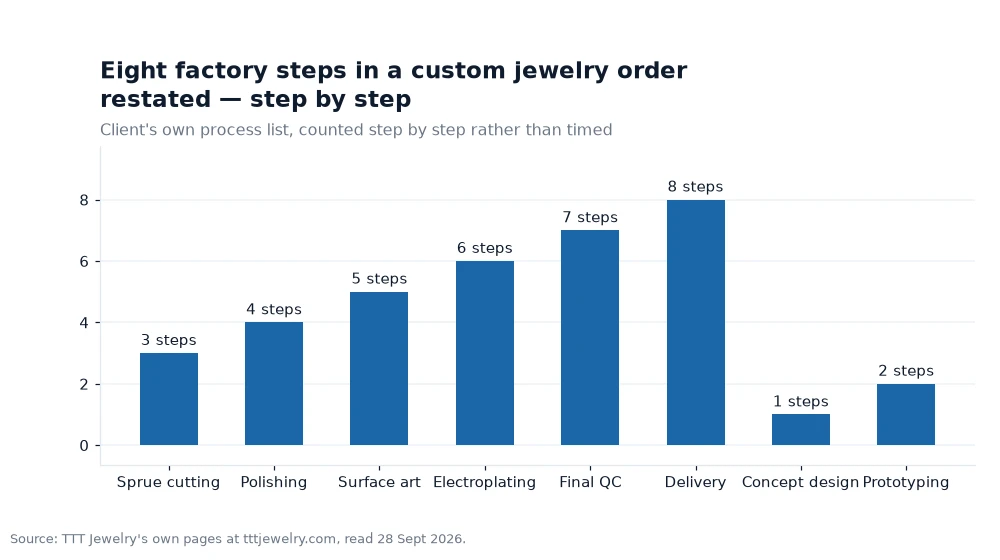
The eight published steps are concept design (1), prototyping (2), sprue cutting (3), polishing (4), surface art (5), electroplating (6), final quality control (7) and delivery (8). Electroplating therefore sits at step 6 of 8, which is 6 ÷ 8 = 75% of the way through the sequence.
Two steps follow it: inspection and delivery. That means five of the eight steps, or 62.5%, are completed before any plating is applied, and the surface that receives a mark is only final at step six.
The arithmetic is mine; the step order is published. The conclusion is practical: a marking decision taken at the CAD stage has five steps of finishing in front of it, so it should be confirmed in writing rather than assumed from a render.
Frequently asked questions
Which purity mark is used for each material?
S925 for 925 sterling silver, 316L for stainless steel, and 18KGP for gold-plated pieces, applied by high-precision laser engraving.
Can a logo and a purity mark be engraved together?
Yes. Both are applied by the same laser engraving step, so they are normally specified in one message along with the surface they will sit on.
Is 18KGP the same as solid 18K gold?
No. 18KGP marks a gold-plated piece, which is why the plating specification matters as much as the mark itself.
Specifying marks before the run starts
Write the mark into the technical message that opens the order, next to the material and the finish, because the three are one decision. The six-step OEM/ODM workflow places that message at the inquiry stage, which is where it costs nothing to change.
For pieces where the mark will sit on plated brass rather than a precious metal, the eco-brass specification page sets out the plating and coating options that the mark has to describe accurately.
The figures used above — the three service strands, the five service steps plus sampling over 25–30 days — are drawn from the brand's own pages at the tttjewelry.com address (read 28 Sept 2026). The arithmetic in the worked example is mine, not the site's[1].